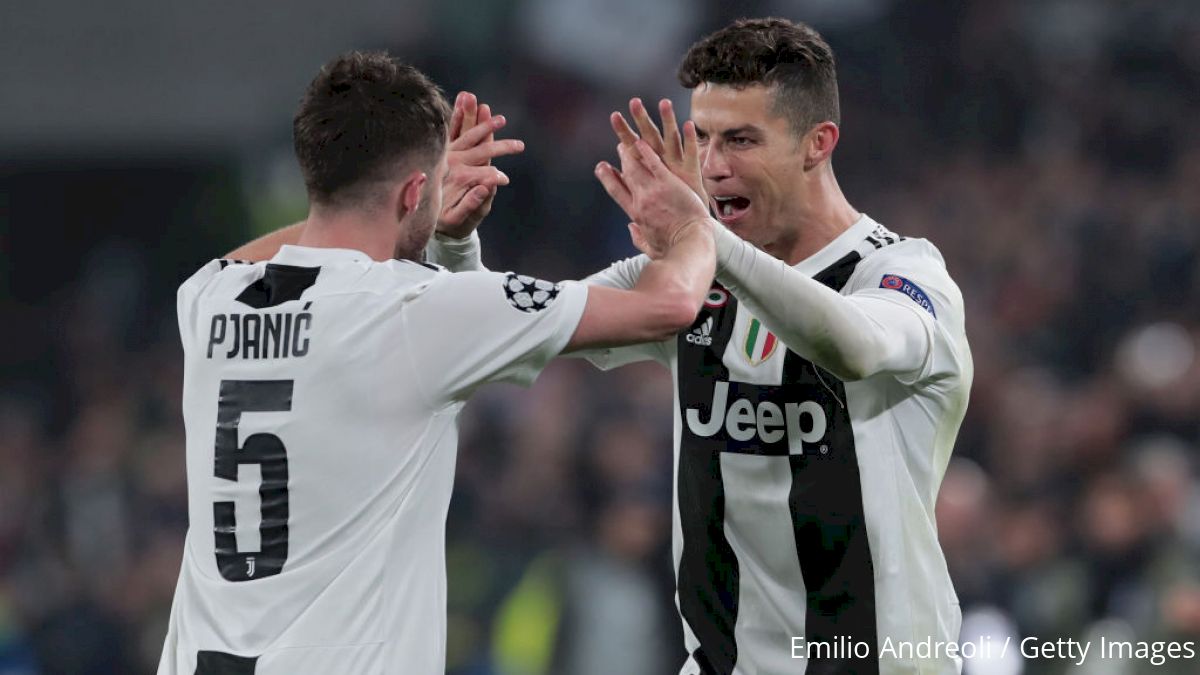
Two years ago in Cardiff on June 3, Real Madrid completely obliterated Juventus in the Champions League final. Although the game was tied at the half thanks to Mario Mandzukic’s stunning bicycle kick, the 4-1 rings true to how one-sided the game was. Zinedine Zidane’s side controlled possession with 55 percent of the ball, doubled the Old Lady in shots (18-9), and rubbed salt in the wounds thanks to a red card from Juan Cuadrado and a 90th-minute goal.
Nowhere on the pitch was that obliteration so apparent as in the midfield.
Juventus started Miralem Pjanic and Sami Khedira; Real Madrid started Casemiro, Luka Modric, and Toni Kroos.
The Bosnian held his own, firing three shots, one of which tested Keylor Navas in the first half and could’ve turned the tides of the game, but he was substituted off the field at 70 minutes. His German counterpart put together a forgettable appearance to say the least, registering only 42 touches in the full 90 minutes. Khedira had no shots, no key passes, and no dribbles. Defensively he mustered two total tackles and a clearance.
On the other side, the Real Madrid midfielders could not have looked more different. Casemiro bossed the midfield with seven total tackles. Kroos touched the ball 89 times with two key passes and 92-percent accuracy. And Modric collected an assist and completed six of seven long balls.
In other words, Juventus were dismantled in the midfield. That day the Old Lady had many issues—struggling with injuries, formational questions—but the midfield was the major red flag at the beginning of the day, and the white flag at the end of the day.
Two years later, after scraping through the round of 16 thanks to a Cristiano Ronaldo hat trick against Atletico Madrid, Juventus are in the same position: fighting an uphill battle in the Champions League thanks to a subpar midfield.
Every Juve midfielder besides Pjanic is seriously flawed
Juventus may well go on to win the Champions League. Max Allegri is one of the best managers in the world, despite his detractors, and Cristiano Ronaldo remains, after all these years, Cristiano Ronaldo. But Juventus are not the favorites at this point, and that’s because of the midfield.
With Giorgio Chiellini and Leonardo Bonucci—despite the latter’s struggles—the defense is still one of the world’s best, a combination of brute strength, marking precision, and distributive skills. Allegri has at his disposal a bevy of options in the fullback position, from the offensively minded Joao Cancelo to the stalwart Mattia de Sciglio. Wojciech Szczęsny is one of the most underrated goalkeepers in Europe. And the attacking unit boasts, in addition to Ronaldo, Paulo Dybala, Federico Bernardeschi, Mario Mandzukic, and more.
But in the midfield, only Pjanic qualifies as a top player.
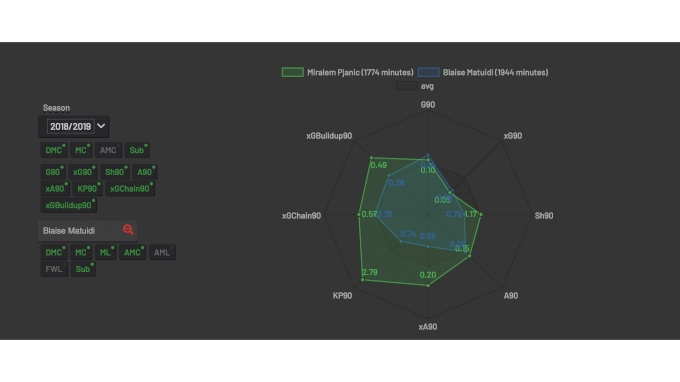
Blaise Matuidi serves an important role for Juventus—and for France—and functions best in a three-man midfield. As you can see in the Understat radar, which focuses on build-up and distribution stats, Pjanic is virtually better by almost any offensive metric, the exceptions being goals per 90 minutes and expected goals per 90 minutes. Of course the radar doesn’t track tackles, interceptions, distance run, pressure and pressure effects, etc. That’s why Matuidi earns his paycheck—especially when Cristiano Ronaldo is playing as a left winger and not tracking back. Matuidi also makes some intelligent runs into the box, although his poor touch prematurely ends a lot of his good work.
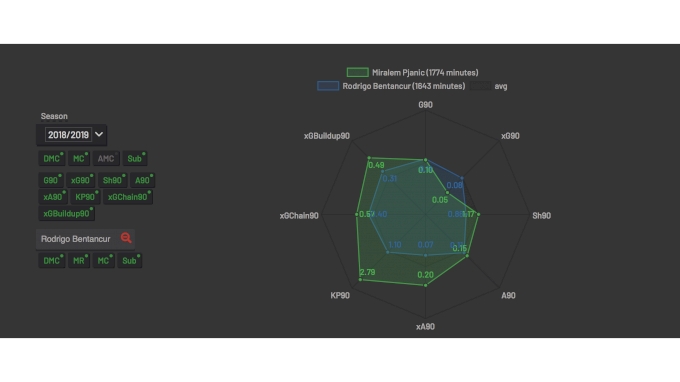
Rodrigo Bentancur is only 21 years old, and he’ll certainly fit into Juventus’ plans over the foreseeable future in the midfield, probably as more of a box-to-box player rather than a deep-lying playmaker like Pjanic. He’s one of the most balanced midfielders Juventus have, and Allegri has given him a variety of roles this year in the midfield. But he’s still quite streaky—he’ll be spot-on in one game and either absent or boneheaded in the next.
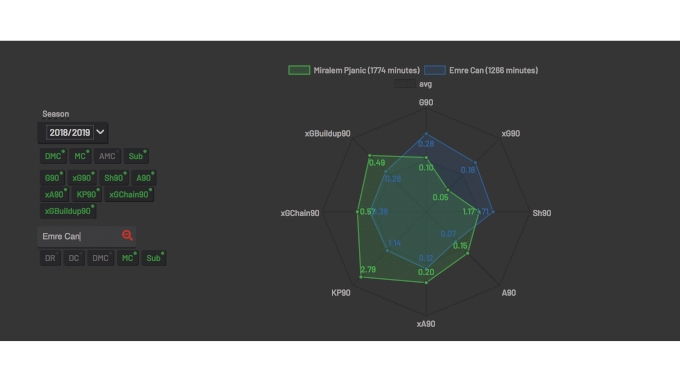
Emre Can’s first few months at Juventus were not good at all; he looked completely lost no matter how or where Allegri deployed him. But the German has improved significantly, his best game by far coming in Turin in the second leg of the Champions League against Atletico Madrid. In that marvelous comeback for the Old Lady, Allegri used Can as a third center back for much of the game, which allowed him to strategically decide when to move forward on runs; his distribution was markedly more on-point and he looked calmer on the ball.
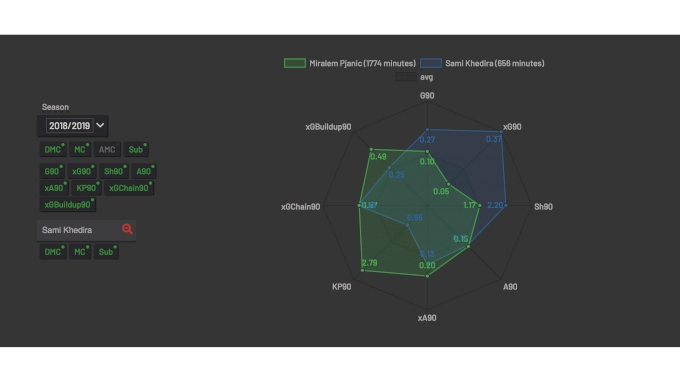
Khedira and Pjanic are different players used in distant roles by Allegri, the former used much higher up the pitch and to add a goal-scoring threat now later in his career. The problem with Khedira, though, is two-fold: First, he’s not able to maintain that sort of scoring threat over the course of 90 minutes or against the best competition—for instance, against the Casemiros of the world; after all, Khedira is 31 years old. Second, even though he’s used less as a distributor and more as an attacker, the ball seems to die at his feet more and more.
Pjanic is the only Juventus midfielder without a serious deficiency—he’s a solid defender, a very good distributor, good with the ball at his feet, good in a variety of roles, and although he’s not the perfect player every single game he’s the Old Lady’s most consistent variable in the center of the pitch.
All radars courtesy of Understat.com
CR7: A no-brainer with enormous financial & tactical risk
Juventus acquired Cristiano Ronaldo less than a year ago, and only now after all these months have I distilled my reaction into two coherent thoughts on the move. Neither is revolutionary or perhaps even very interesting, but I think where there is some interest is in thinking of the two seemingly opposing conclusions together.
Thought No. 1: If you have a chance to sign Cristiano Ronaldo, even at age 33 as he was last summer, you sign Cristiano Ronaldo.
Thought No. 2: The move was an enormous financial risk for the club given CR7’s transfer fee and salary concerns, but it was also an enormous risk tactically speaking in that the club needed to scramble to rearrange its attack (jettisoning Gonzalo Higuain to AC Milan and now Chelsea) and didn’t address its most pressing need (midfield).
The Juventus brass made a conscious decision to ignore what quite clearly needed the most help in the midfield. Last year’s attack was humming along just fine. Dybala led the team in scoring, and Higuain did well, too. The team scored 86 goals in Serie A, second-most and trailing Lazio by only three. Players like Bernardeschi and Douglas Costa were integrated more and more. There was improvement and cohesion.
Then Ronaldo arrived. Higuain got kicked to the curb, and Dybala has only bagged nine goals across all competitions. Douglas Costa has been conspicuously absent since an ugly spitting incident in the fall and several minor injuries. The main beneficiary has been Mandzukic, but even the big Croat has been struggling for form in the last couple of months. Sure, Juventus are winning, but their play since the new year has been stellar in only a single game: the comeback in Turin. They’ve sputtered with lackluster performances in league play and face an uphill battle even if they get past Ajax.
And none of that is even to mention the midfield.
Had Juventus spent the Ronaldo money elsewhere, they could’ve gone after someone like Jorginho or Sergej Milinkovic-Savic—and still had plenty of money left over to strengthen the squad with much-needed younger players.
The success or failure of the Ronaldo move rides on a Champions League crown in the next four years, and the clock is ticking.
The addition of Aaron Ramsey over the summer is going to help the Juventus midfield immensely. At 28 years old, he’s young enough to get up and down the pitch, and he plays a much more offensively minded role like Can or Khedira but is exponentially better with the ball at his feet and in distribution. He won’t be asked to do the heaviest lifting defensively—especially if Allegri keeps playing a three-man midfield as has been his preference—given the work rate the skipper requires from everyone not named Ronaldo.
But even in a best-case scenario in which the Welshman integrates quickly and stays healthy—a major concern for the player—he’s not going to make this midfield world-class overnight. And he’s not getting any younger; nor, for that matter, is Miralem Pjanic, who turns 29 today.
The serious deficiencies of the rest of Serie A have masked some of Juve’s problems in the midfield, but until the Old Lady turn their eyes to seriously improving that unit, they’re still going to be fighting an uphill battle against Europe’s best.